 Call us 02381550266
 contact@websqr.co.uk
 The Website Agency
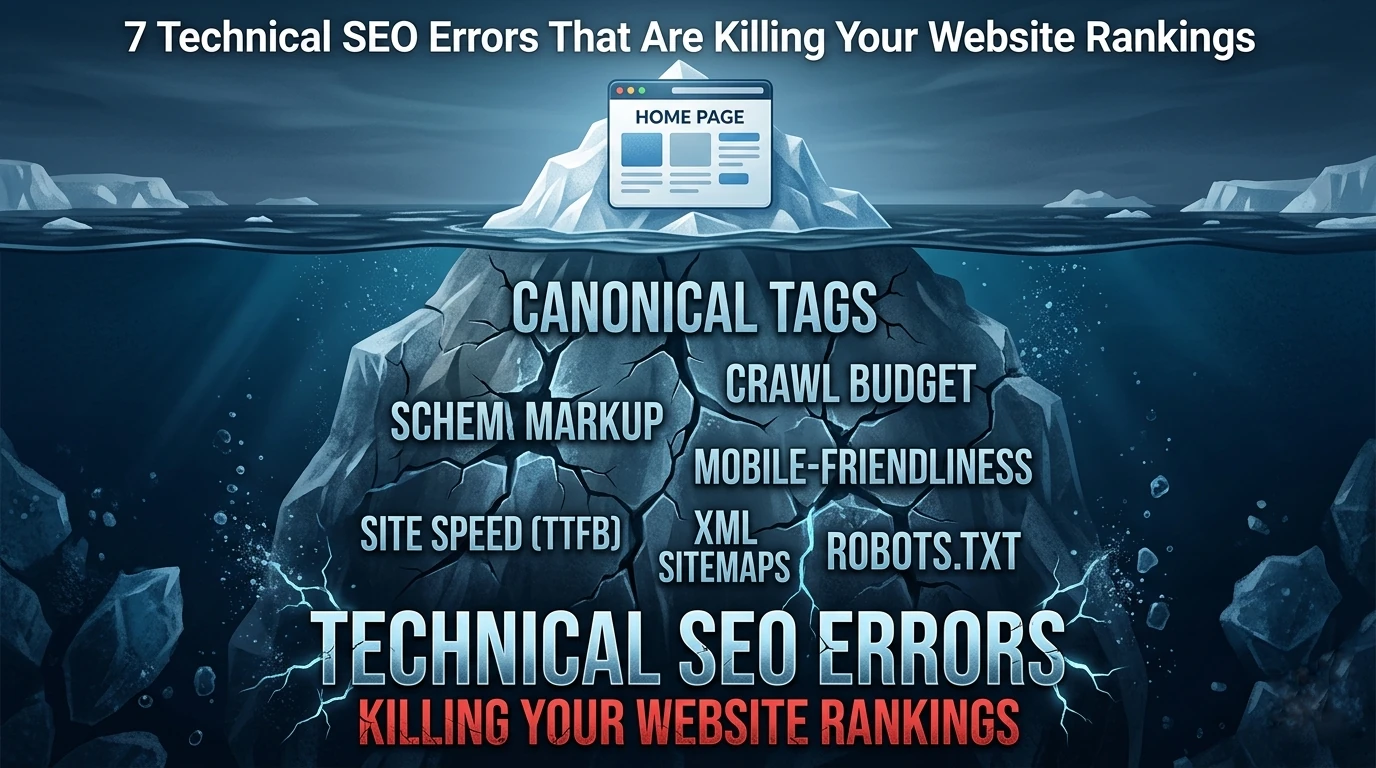
You can write the most brilliant content in the world, but if your website’s “engine” is broken, Google won’t let you leave the starting line. In 2026, search engines prioritize User Experience (UX) and Technical Health more than ever.
If your impressions have plateaued or your rankings are slipping, check your site for these seven silent killers.
1. Slow Page Load Speed (The 3-Second Rule)
Google knows that users are impatient. If your site takes longer than 3 seconds to load, your bounce rate will skyrocket.
- The Fix: Use Google PageSpeed Insights. Compress your images, minify your CSS/JS code, and ensure you are using a high-quality hosting provider. Slow speed is an immediate ranking penalty.
2. “Mobile-First” Failures
Google primarily uses the mobile version of your content for indexing and ranking. if your buttons are too close together or your text is too small on a smartphone, you will disappear from search results.
- The Fix: Test your site on multiple devices. Ensure your design is responsive and that no “pop-ups” are blocking the main content on mobile screens.
3. Broken Internal Links (404 Errors)
Remember the “window” metaphor from our [beginner’s SEO guide]? A broken link is like a window with a “Closed” sign on it. It stops Google’s crawlers in their tracks and tells the algorithm your site is poorly maintained.
- The Fix: Run a monthly crawl using tools like Screaming Frog or Ahrefs. Redirect any broken 404 pages to relevant, live content using 301 redirects.
4. Poor Site Architecture (The “Click” Depth)
If it takes more than three clicks to reach your most important pages from the homepage, Google (and users) will struggle to find them. This is known as “Deep Crawling” issues.
- The Fix: Use a flat site structure. Ensure your “Big Box” content and service pages are linked directly from your main navigation or high-level category pages.
5. Duplicate Content & Canonical Tags
If you have multiple versions of the same page (e.g., http vs https or tracking URLs), Google gets confused about which one to rank. This “cannibalizes” your SEO authority.
- The Fix: Implement Canonical Tags (rel=”canonical”). This tells Google: “I know there are copies, but THIS is the master version you should rank.”
6. Missing or Generic “Alt Text” for Images
Search engines cannot “see” images; they read the code behind them. If your images are named IMG_1234.jpg with no Alt Text, you are missing out on Google Images traffic and accessibility points.
- The Fix: Every image should have descriptive Alt Text. Instead of just “Box,” use “Corrugated cardboard shipping box for heavy-duty items.”
- The Workflow Challenge: For Shopify store owners with hundreds of products, writing these manually is a bottleneck that often gets ignored, killing your search visibility.
Pro Tip for E-commerce: You don’t have to write these one by one. You can automate this entire process and ensure every product is optimized by using an app that generates alt texts for product images. This ensures your store remains accessible and searchable without the manual grind.
7. Lack of HTTPS Security
In 2026, security is a non-negotiable ranking factor. If your site shows a “Not Secure” warning in the browser bar, Google will actively push users toward your competitors.
- The Fix: Ensure your SSL Certificate is active and that all “Insecure” content (http) is automatically redirected to https.
Is Your Technical Foundation Solid?
Technical SEO is the “Fine Detail” phase we mentioned in our SEO framework. While keywords get people to your site, technical health keeps them there and keeps Google coming back.
Does your website feel sluggish or outdated? Our agency specializes in technical audits that clear the path for your content to reach #1.