 Call us 02381550266
 contact@websqr.co.uk
 The Website Agency
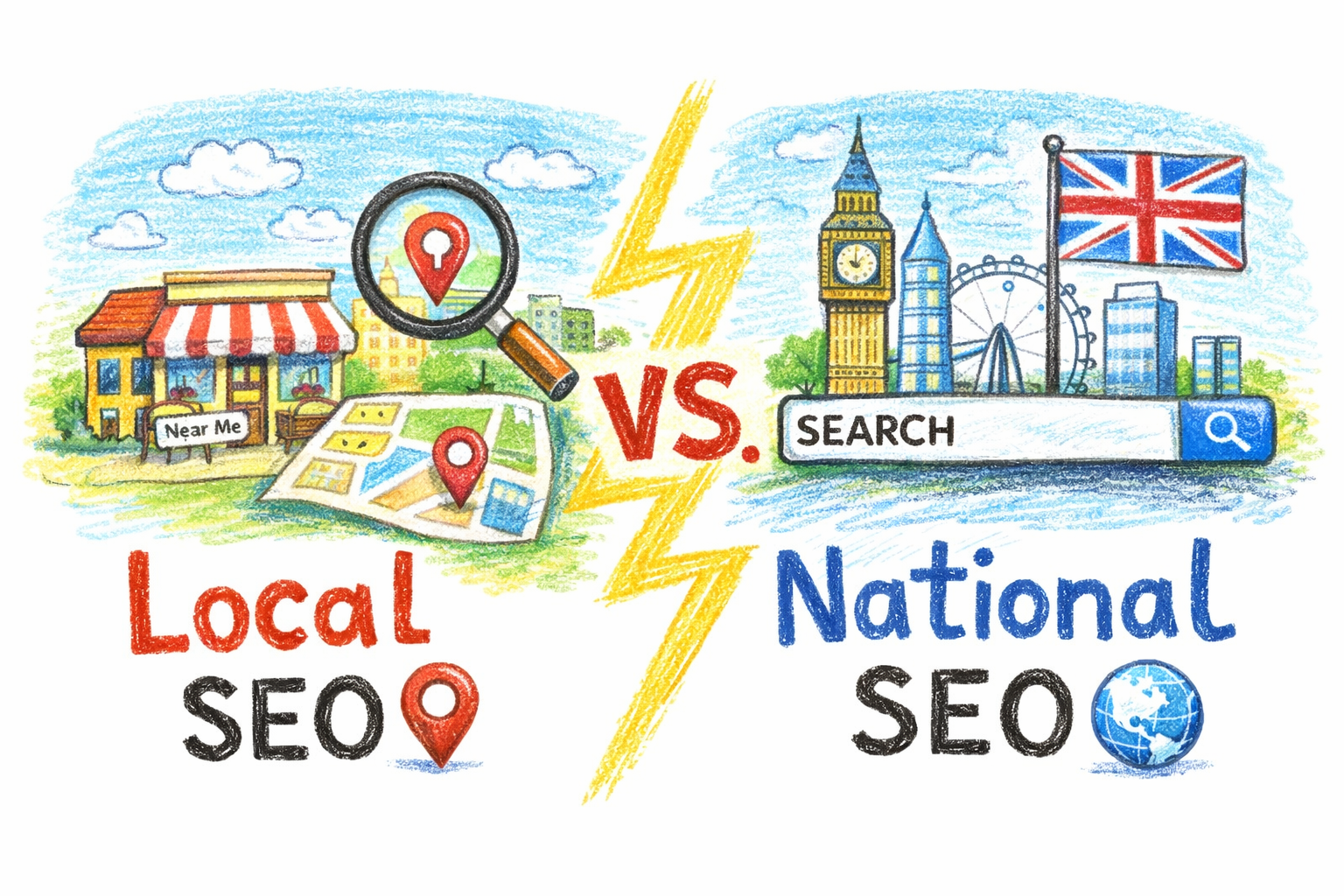
One of the most common mistakes in digital marketing is trying to rank for “everything” at once. In SEO, if you try to speak to everyone, you often end up reaching no one. While the core principles found in our foundational guide on how to rank on Google apply to every website, the specific tactics you use will shift depending on where your customers are located.
In 2026, Google’s algorithm distinguishes sharply between Local Intent (finding a service nearby) and National Intent (finding the best product or information regardless of location). Understanding which path to take is the difference between a wasted budget and a high-ranking website.
1. Local SEO: The “Near Me” Advantage
Best for: Brick-and-mortar shops, local service providers, and regional businesses.
Local SEO is designed to capture users looking for immediate solutions in their geographic area. It relies heavily on your Google Business Profile and “NAP” (Name, Address, Phone number) consistency across the web.
- The Goal: To appear in the “Map Pack” (the top three local results on Google).
- Key Ranking Factor: Reviews. Google doesn’t just look at your star rating; it looks at the frequency and recency of your feedback. To bridge the gap between your search profile and your website, many businesses integrate live Google reviews directly into their pages. This helps maintain a consistent “trust signal” as users move from Google Maps to your actual store.
2. National SEO: The Authority Game
Best for: E-commerce stores, SaaS companies, and digital agencies.
National SEO is significantly more competitive. You aren’t just competing with the shop down the street; you are competing with every major brand in the country.
- The Goal: To rank for broad, high-volume keywords (e.g., “Organic Skincare” vs. “Skincare Shop London”).
- Key Ranking Factor: Topic Authority. You must build a massive library of content that proves you are an expert. This requires the “Topic Cluster” strategy—writing deeply about specific subjects and linking them together to create a web of expertise.
3. The Technical Bridge: Schema Markup
Whether you are targeting a local neighborhood or the entire country, Google needs to “read” your reputation. This is done through Schema Markup (JSON-LD)—a snippet of code that tells search engines, “This business has a 4.9-star rating.”
Implementing this code manually is a technical hurdle for most. A clean way to handle this is by using SEO-friendly review widgets that automatically inject the necessary JSON-LD schema into your theme. It’s a “set-and-forget” way to ensure your search results show those coveted gold stars, which significantly improves Click-Through Rates (CTR).
Local vs. National: A Quick Comparison
| Strategy | Primary Focus | Success Metric |
| Local | Proximity & Local Reviews | Calls, Directions, Foot Traffic |
| National | Content Depth & Backlinks | Organic Sessions, National Sales |
| Technical | NAP Consistency & Local Schema | Site Speed & Global Trust Signals |
Which Path Should You Take?
If your business has a physical location where you meet customers, Local SEO should be your priority. It offers a faster return on investment and lower competition.
If you sell products online via a platform like Shopify and can ship anywhere, National SEO is your long-term engine for growth. In this case, your focus should be on building trust at scale by showing that customers across the country are happy with your service.